
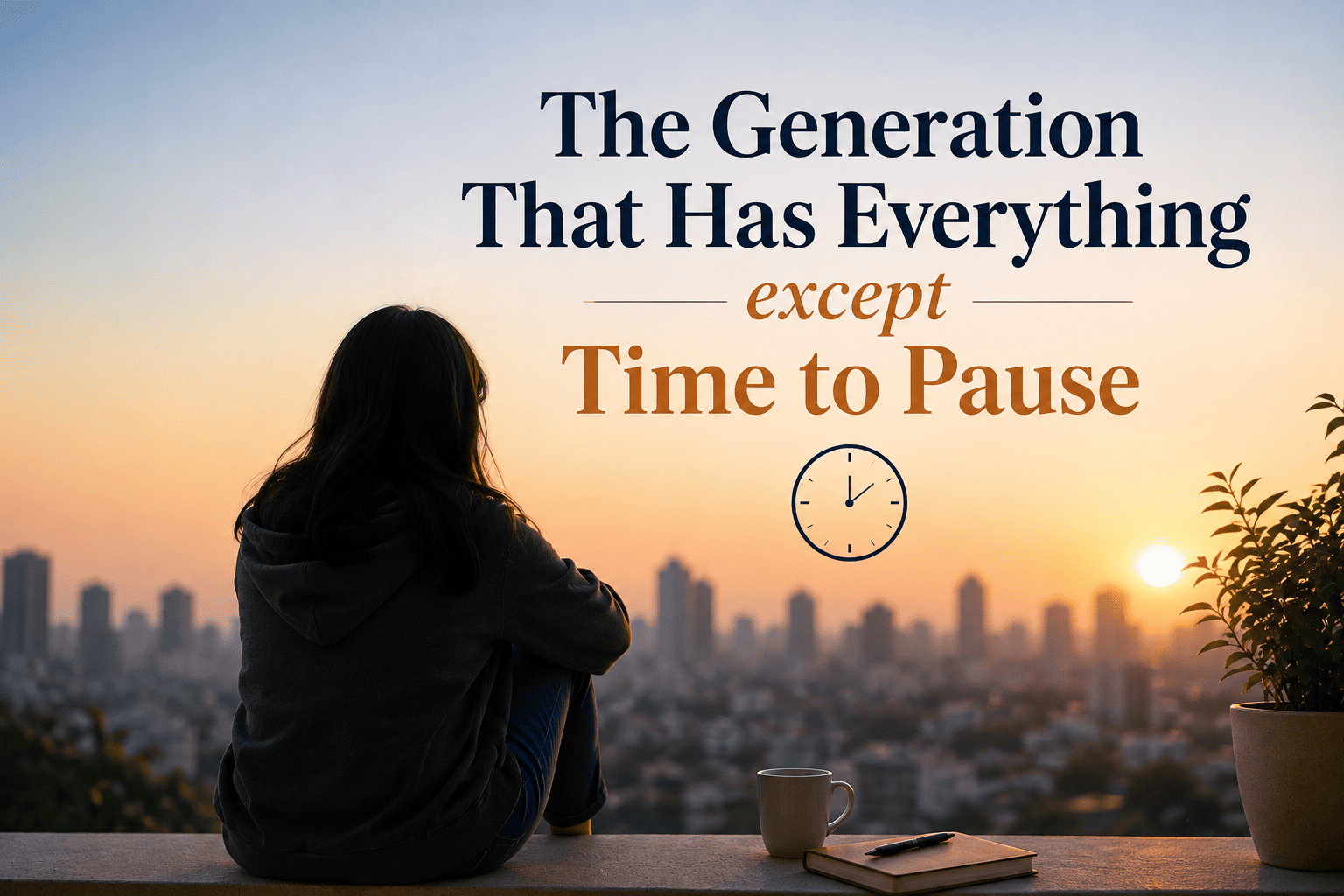
The Generation That Has Everything except Time to Pause
Blog By - Proma Mukherjee (Grade - IX)
We have never possessed so many ways to save time.
Food arrives at our doorstep. Messages cross continents in seconds. Artificial intelligence can compress hours of work into minutes. Entertainment follows us everywhere. Even boredom now seems to have an app designed to eliminate it.
And yet, somehow, we are perpetually short of time.
That may be the great paradox of our generation: everything around us is getting faster, but very few of us feel less rushed.
Our calendars are crowded, our screens are even more crowded, and the spaces between activities have gradually been occupied by notifications, reels, reminders and the persistent pressure to do something useful.
Henry David Thoreau once observed, “It is not enough to be busy. So are the ants. The question is: What are we busy about?”
Perhaps that question deserves to interrupt us for a moment.
We have almost engineered boredom out of existence
Think about the last time you stood in a queue, waited for a lift or arrived somewhere ten minutes early.
Did you simply wait?
Probably not.
The phone appeared almost instinctively.
Not because something urgent had happened. Simply because nothing was happening.
We have developed an extraordinary intolerance for unoccupied moments.
Earlier generations experienced boredom whether they liked it or not. Journeys were longer. Replies took time. Entertainment was not permanently available. Waiting was an unavoidable part of ordinary life.
We have solved that inconvenience impressively.
But perhaps we have also discarded something useful. We have discarded thoughts.
When the mind is not being constantly directed, it wanders. It revisits conversations, makes unexpected connections, retrieves forgotten ideas and notices things that stimulation can easily drown out.
Some of our most original thoughts do not arrive while we are frantically searching for them.
They appear when the mind finally has room to breathe.
We consume at a speed our minds were never designed to process
A ten-minute scroll can contain a natural disaster, a comedy reel, an examination notice, someone’s engagement photographs, political outrage, a travel video, a productivity tip, and an advertisement promising to transform our lives.
The problem is no longer simply information overload. It is insufficient reflection.
Eventually, we may know a little about everything while having deeply considered almost nothing.
Because being informed and being thoughtful are not the same thing. The first requires access.
The second requires time.
Another thing that scares me is that even leisure has become another performance
Our gene/ration has managed to make rest remarkably industrious.
We track our steps, monitor sleep quality, calculate screen time, set reading goals and optimise morning routines.
We schedule relaxation and then occasionally feel guilty for not relaxing productively enough.
Hobbies face the same pressure.
Bake well? Start selling.
Enjoy photography? Build a page.
Love reading? Set an annual target.
Paint beautifully? Perhaps it should become a portfolio.
There is nothing wrong with turning talent into opportunity. But something changes when every interest requires an outcome.
Not everything we love needs to become profitable, measurable or publicly visible.
A walk may simply be a walk.
A hobby can remain gloriously irrelevant to our résumé.
There is something quietly liberating about doing an activity that has absolutely no ambition beyond enjoyment.
There is another reason pausing feels uncomfortable. While we stop, everyone else appears to be moving.
Someone has secured an internship.
Someone is studying abroad.
Someone has won an award.
Someone apparently discovered their life’s purpose at seventeen and also found time to run a half-marathon before breakfast.
We understand intellectually that social media shows selected moments.
Emotionally, however, comparison remains persuasive.
We begin keeping up with the Joneses, except the Joneses now include thousands of people across different countries, careers and stages of life.
The result is not merely envy.It is urgency.
A quiet Sunday begins to feel suspicious.
Should I be learning something?
Should I be applying somewhere?
Am I falling behind?
There is something profoundly exhausting about feeling late for a life that has barely begun.
But we have to understand that our best thoughts often arrive when we stop chasing them
There is a reason solutions appear in the shower, during a walk or just before sleep.
It is not because bathrooms possess unusual intellectual properties.
It is because the brain is briefly released from constant instruction.
A difficult conversation suddenly makes sense. An idea improves. A problem that resisted hours of concentration rearranges itself in a quieter moment.
Pausing is therefore not necessarily the opposite of productivity.
Sometimes, it is part of the process.
Pausing does not require abandoning technology or retreating from modern life.
It can be remarkably simple.
Walk occasionally without headphones. Let one notification wait. Finish a meal before opening another screen. Keep one hobby private. Allow a queue to remain a queue. Sit with an uncomfortable question before searching for someone else’s answer.
These seem like insignificant choices.
They are not.
They return something increasingly scarce: undivided attention.
And what we give our attention to eventually shapes what we notice, what we remember, what we create, whom we understand and what kind of life we actually experience.
Our generation has mastered the art of filling time.
Perhaps the next achievement is learning when not to.
Because in a world relentlessly competing for every second of our attention, the ability to pause is no longer laziness. It is discernment. It is presence.
And perhaps, in an age that gives us access to almost everything, the rarest privilege will be a few moments that belong entirely to us and, most importantly, for us.