Creativity in the Age of AI: What Will Remain Uniquely Human?
Blog By - Bhavya mehta (Grade - X)
Type a sentence.Wait a few seconds.And suddenly there it is.
A poem. A logo. A painting. A business idea. A melody. A presentation that somehow has better alignment than the one you spent three hours making.
Welcome to creativity in the age of AI.
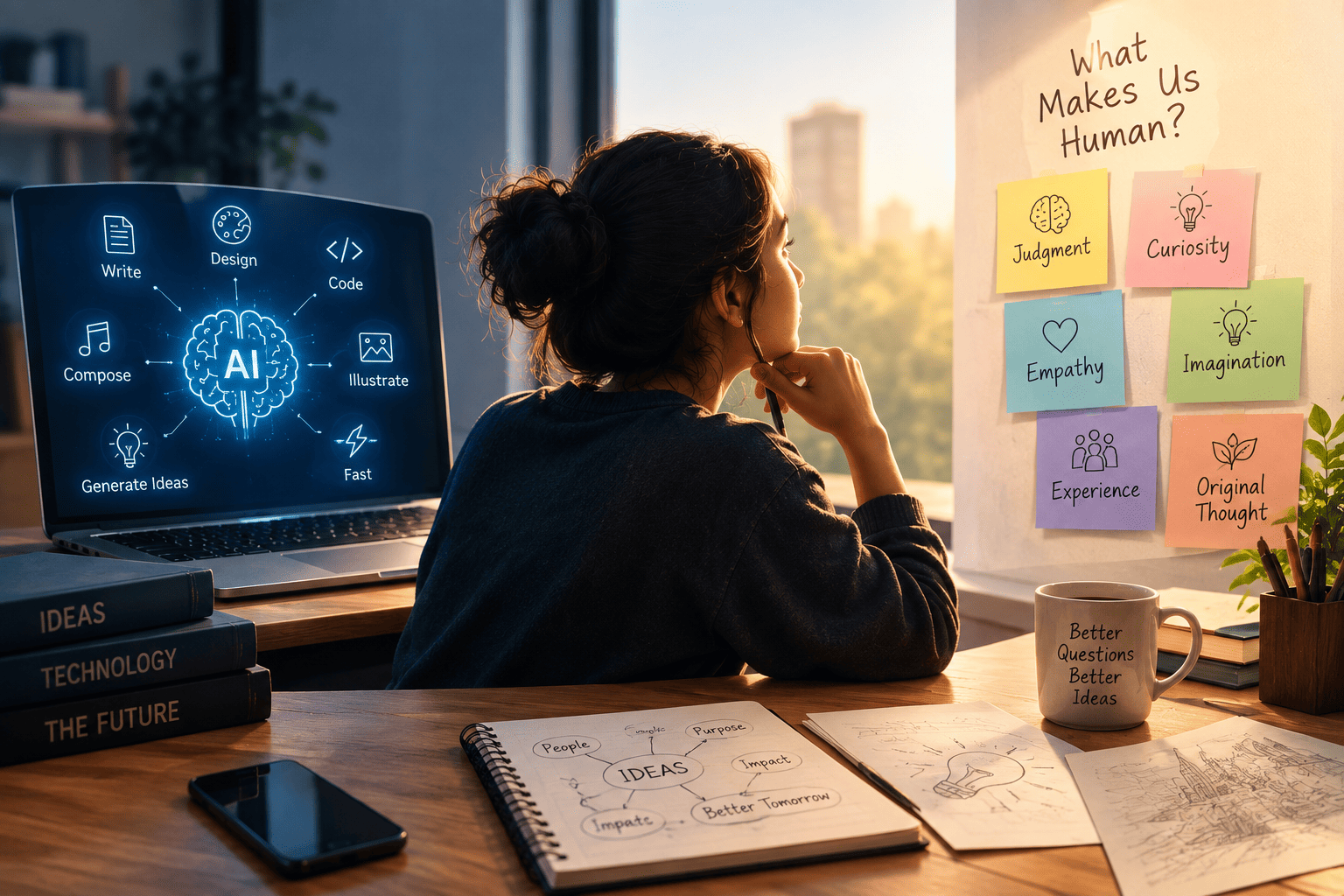
AI can write, design, code, compose, illustrate and generate ideas at extraordinary speed.
Which leaves us with one very obvious question:
If AI is doing everything, what exactly are we supposed to do?
Quite a lot, actually.
But perhaps we need to rethink what creativity really means.
AI can give you 100 ideas. It cannot tell you which one deserves to exist.
Suppose you ask AI to design a chair.
Within seconds, you could have a floating chair, a folding chair, a posture-correcting chair, a chair inspired by a jellyfish and probably a chair that also writes poetry.
Generating possibilities is becoming incredibly easy.
But creativity is not simply about producing possibilities. It is also about choosing between them.
Which idea actually solves a problem? Which one is beautiful but useless? Which one looks ordinary at first but could become extraordinary with another week of work? Which one should never have made it past the first sketch?
That requires something far more difficult than generation.
Judgment.
In a world where everyone can produce more, knowing what is worth keeping may become one of the most valuable creative abilities we have.
And yes, the concern is real. If AI can write, design, code and generate ideas, what happens to jobs that once depended on those skills? The World Economic Forum estimates that by 2030, changes in the labour market could displace 92 million jobs while creating 170 million new ones, with almost 39% of existing skill sets expected to change. Yet the same report identifies creative thinking, curiosity and lifelong learning among the skills growing in importance. An MIT study also found that professionals using ChatGPT completed certain writing tasks around 40% faster, while improving the quality of their work by 18%. So perhaps the challenge is not defeating AI at the things it does quickly. It is becoming better at the things that give that speed direction: judgment, curiosity, imagination, empathy and original thought.
The most creative person may simply be the one who notices first
AI has access to enormous amounts of information.
What it does not have is your Sunday afternoon.
It has never watched your grandmother struggle with a confusing app. It has never stood outside your school and wondered why traffic becomes chaotic at the same time every day. It has never seen a younger student quietly pretend to understand something because asking again feels embarrassing.
Those moments matter.
Creativity often begins before the idea itself. It begins when somebody notices something everyone else has learnt to ignore.
Someone sees water being wasted and imagines a sensor.
Someone notices discarded material and wonders what else it could become.
Someone sees people struggling with a system and asks, Why does it have to work like this?
AI can help develop the answer.
But somebody still has to notice that the question is worth asking.
Your experience is part of your creative toolkit
Give ten people the word home and ask them to create something around it.
One might think of a building.
Another might remember the smell of food coming from the kitchen.
That difference is where creativity becomes personal.
Our ideas absorb our memories, humour, disappointments, relationships, culture and experiences. The books we read, the mistakes we make, the people we meet and the things we care about quietly become part of whatever we create.
AI can recognise patterns across millions of examples.
But your perspective comes from a combination of experiences that no one else has lived in exactly the same way.
So originality in the future may not always mean creating something that has never existed before.
It may mean bringing a way of seeing that belongs specifically to you.
Perfect may become surprisingly ordinary
For years, technology has helped us remove imperfections.
Sharper photographs. Cleaner designs. Better grammar. Smoother editing.
AI takes that one step further. It can produce technically polished work almost instantly.
But what happens when polished becomes normal?
A slightly uneven sketch may suddenly feel more interesting because we can see the person behind it. A handwritten note may feel more meaningful than an immaculate generated message. A strange sentence may stay with us precisely because it does not sound like everything else.
In a world overflowing with perfect-looking content, human fingerprints may actually become more valuable.
The goal is not to avoid AI. That would make very little sense.Use it to brainstorm. Research. Prototype. Rewrite. Test alternatives. Improve a weak idea.But leave something of yourself in the final result.Otherwise, technically excellent work can become strangely forgettable.
Creativity also means knowing when the answer is wrong
Imagine AI produces a brilliant advertising campaign. Excellent design. Clever slogan. Perfectly written copy. There is just one problem.It unintentionally insults the very people it is supposed to reach.
Technically impressive?
Yes.
Good creativity?
Not really.
Creativity involves more than making something attractive. It requires understanding people, context and consequences.So perhaps another uniquely human creative skill will become increasingly important: the confidence to look at a sophisticated result and say,
No. This does not feel right.
That requires empathy and responsibility. Neither fits neatly inside a prompt.
Maybe originality is about to get stranger
AI is very good at giving us versions of things that already work..
Which means the creative advantage may increasingly belong to people willing to move beyond the first sensible answer.
Combine two ideas that normally do not belong together.Explain science through theatre.
Turn waste into design.Use technology to solve an oddly specific local problem.
Question the obvious format.
Because creativity has always contained a little bit of refusal.
A refusal to accept the first answer.
A refusal to believe that something has to remain the way it is.
AI does not remove that instinct.
It may make it more valuable.
So what are we supposed to do?
Not compete with AI over who can generate twenty ideas faster.
We already know who wins that one.
Our job is to become better at noticing, questioning, choosing, connecting and caring.
Use AI to expand an idea, not replace the need to have one.
Let it save time, then decide what deserves that saved time.
Let it produce twenty possibilities, then search for the twenty-first.
Let it help you create faster, but do not allow speed to become the definition of creativity.
Because when almost anyone can generate something impressive, being impressive will no longer be enough.
The people who stand out will be the ones who can bring judgment, experience, curiosity, empathy and a point of view to what technology makes possible.
Maybe that is what will remain uniquely human.
Not our ability to make more.
Our ability to decide what is worth making at all.