AI in the Classroom: Co-Pilot or Ghostwriter?
Blog By - Yohana Lalwani (Grade - IX)
There is a new presence in the classroom. It never forgets homework. It can explain algebra at midnight, simplify Shakespeare, generate code, suggest a science model and produce a polished essay before most students have decided how to begin one.
Artificial intelligence has entered education so quickly that debating whether students should use it already feels outdated. They are using it.The real concern is what kind of learner “that use” is creating.
Imagine two students working on the same assignment. One struggles with the topic, writes an imperfect draft and then uses AI to identify gaps, sharpen the argument and improve clarity. The other enters the question into a chatbot, receives a sophisticated response, changes a few words and submits it. Both pieces may look excellent.But only one student has actually developed a skill. And that difference is far more important than the final grade.
Also we have to understand that the bigger danger is borrowed brilliance. A student can submit an impressive essay without being able to explain the idea behind it. A flawless presentation can hide very little understanding. A piece of code can work perfectly while the person presenting it has no idea why.
The output looks intelligent. The learner may not be. And most importantly, education has never been only about producing polished answers. Much of the learning happens in the messy part.
The paragraph rewritten three times.The mathematics problem that refuses to work.The experiment that fails.The idea that collapses after one difficult comment.Those moments are inconvenient, but they build judgement, resilience and intellectual independence.
But rejecting AI completely would be equally shortsighted
Imagine struggling with a difficult physics concept and asking AI to explain it as if you were twelve. Suddenly, something that seemed impossibly technical begins to make sense.
Stuck on an English thesis? Use AI to explore five possible angles, then develop your own.Preparing for an examination? Ask it to create practice questions around your weakest topic.Written a rough draft? Let AI identify logical gaps, unclear sections or stronger vocabulary.
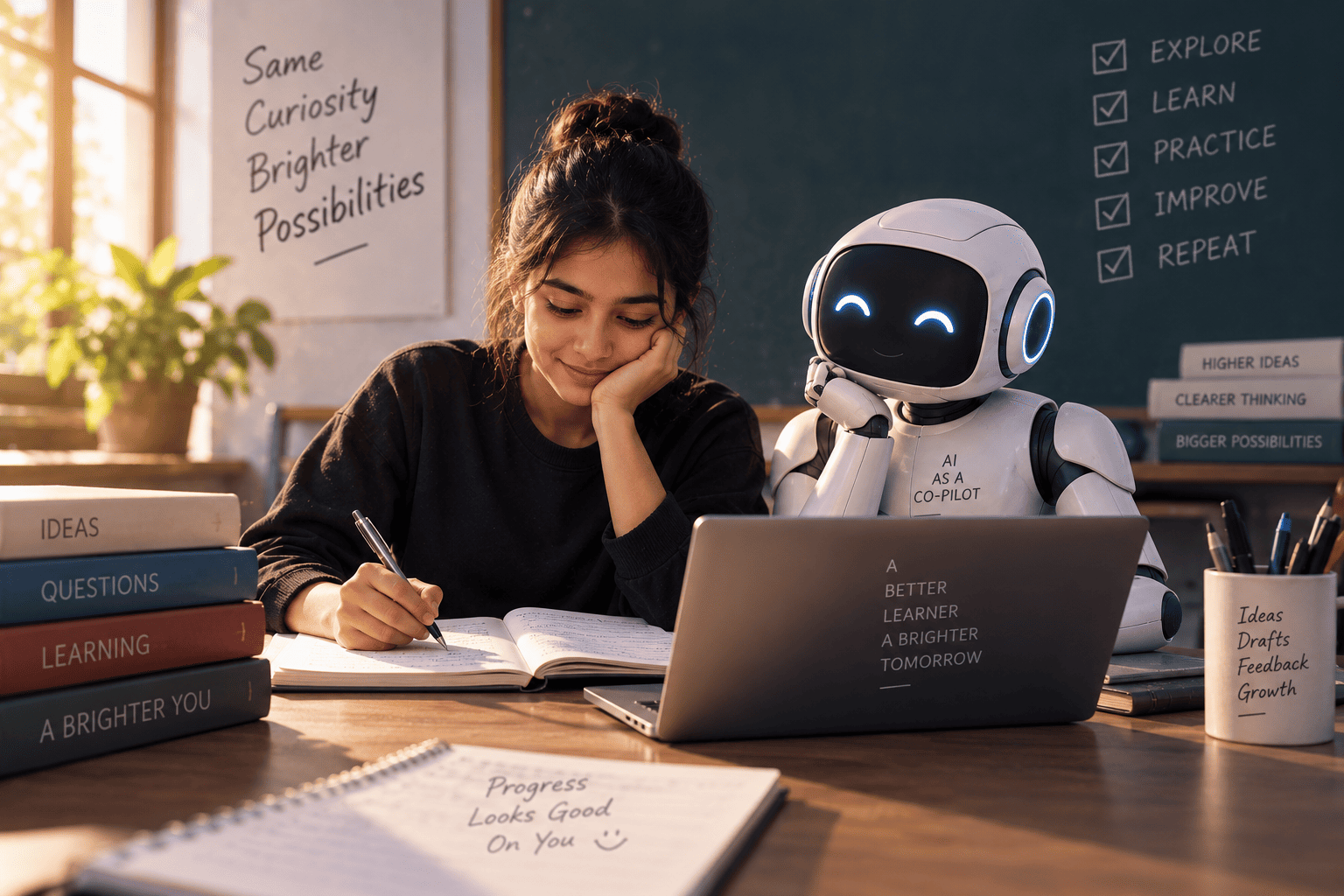
In each of these situations, the student remains in control. AI is not doing the journey; it is clearing some of the turbulence.
That is what a co-pilot should do.
So what should responsible AI use actually look like in a classroom?
Perhaps the most useful guardrails are not complicated ones.
A student should be able to show some evidence of thinking before AI enters the process: a rough outline, handwritten notes, a first attempt or even a few questions they genuinely struggled with.
If AI has been used, that use should be acknowledged rather than hidden. Not as a confession, but as part of the learning process: I used AI to improve structure, generate practice questions or challenge my argument.
And perhaps every important AI-assisted assignment should include one human checkpoint: a brief oral explanation, an in-class reflection, a live problem or a follow-up task that requires the student to apply the same idea independently.
These guardrails do not ban AI.They simply make it harder for students to disappear behind it. Used wisely, AI can make students more curious, more independent and more capable. Used carelessly, it can produce excellent work while leaving very little learning behind.
So the line between co-pilot and ghostwriter is not difficult to find.A co-pilot helps you understand more.A ghostwriter helps you submit more.
One strengthens the student.
The other strengthens only the assignment.
And in the end, education was never about producing perfect pages.
It was about building minds that could think, question, create and decide for themselves.
Therefore AI may deserve a seat in the classroom.But it should never take the student’s place in the learning.
Because the future may indeed be written with AI beside us.But we should still be the ones holding the pen.