
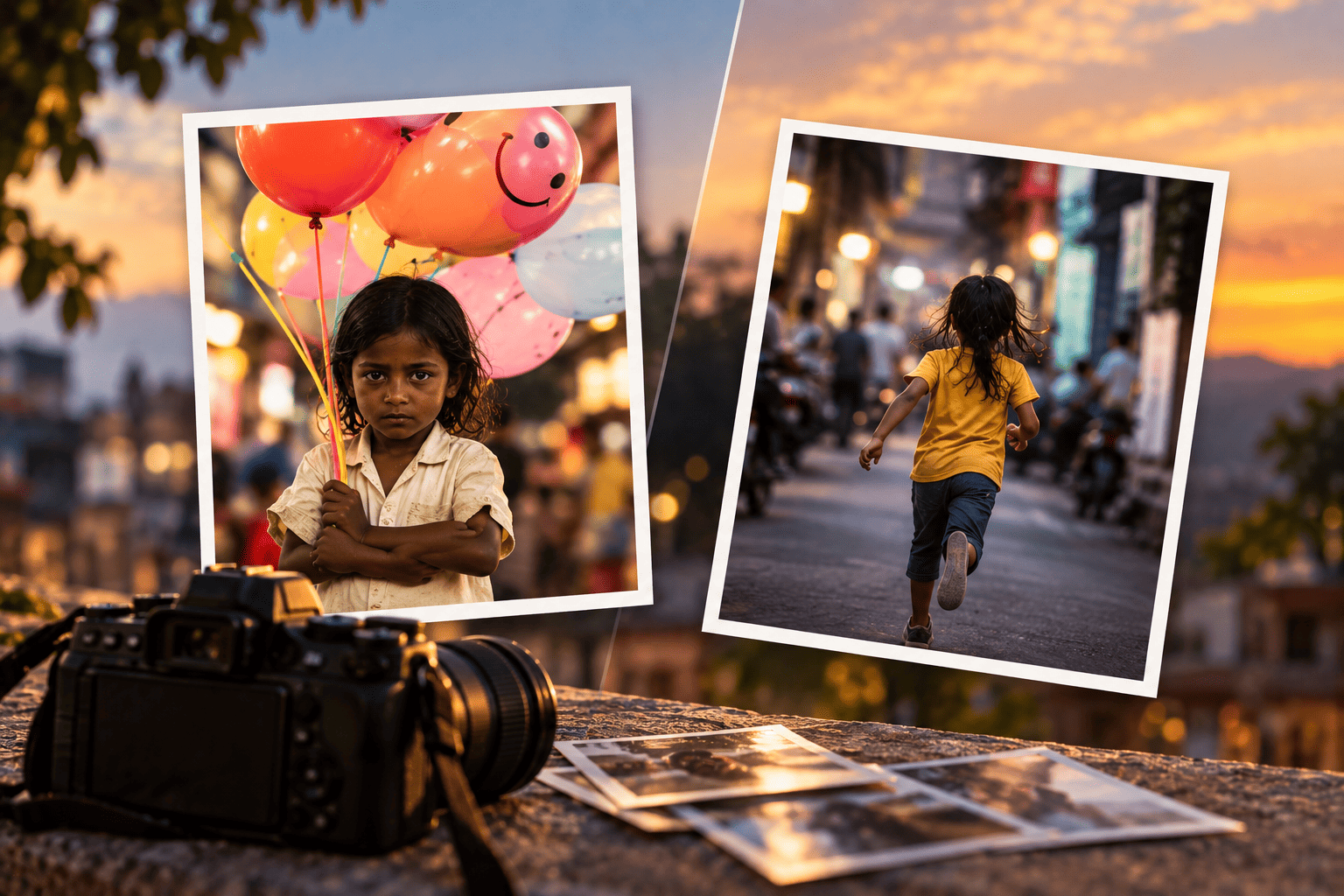
Look at this photograph for five seconds.
A little girl stands beneath a cluster of bright balloons. The balloons are cheerful—round faces, loud colours, cartoon smiles. Her expression is not. Almost instantly, the mind begins to fill in the blanks. Perhaps she is selling them. Perhaps she has been standing there for hours. Perhaps those balloons are her livelihood, her hope, her childhood tied together by a few strings.

What story did your mind create?
But pause. How much of that did the camera actually tell us?
A photograph captures a fraction of a second. Everything before it disappears. Everything after it is still unknown. And yet, we are remarkably quick to turn that fraction into a complete story. We do not merely look at photographs; we interpret them, decorate them with assumptions and sometimes mistake our imagination for truth.
That is what makes photography so powerful—and so dangerous.
We often hear that a picture is worth a thousand words. The problem is that the picture does not always choose those thousand words. We do.
Now look at the second photograph.

What happened five seconds before this frame and five seconds after it?
A girl in a yellow T-shirt is running away from the camera. Was she late? Was someone chasing her? Had she just heard exciting news? Was she rushing home? Within moments, an entire film can begin playing inside our heads.
The real explanation is far simpler: she ran because she was frightened of the camera.
Suddenly, all those dramatic stories collapse.
That small revelation changed the way I think about photographs. A camera can record what was visible, but it cannot automatically record motive, history, emotion or context. The lens shows us what happened inside the frame; it does not promise to explain why.
And in a world where we scroll through hundreds of images every day, that distinction matters more than ever.
A cropped photograph can make a crowded room look empty. One frozen expression can make a happy person look miserable. A perfectly timed image can make an ordinary afternoon look like a perfect life. On social media, we often compare our unedited days with someone else’s carefully selected seconds. In news and advertising, a single image can influence what we feel before we have even read the full story.
The camera may be honest about what it sees, but the frame is always selective.
Perhaps that is why being a photographer requires more than knowing lighting, angles and shutter speed. It requires responsibility. Before pressing the button, there are questions worth asking: Am I observing this person, or turning them into a story they never agreed to tell? Am I capturing dignity, or simply chasing a dramatic frame? What have I left outside the photograph that might completely change its meaning?
Ansel Adams famously said, “You don’t take a photograph, you make it.” I used to think that meant composition, the light, the angle, the patience behind the perfect shot. Now I think it means something more. A photograph is ‘made’ not only by the person behind the camera, but also by the person looking at it. The photographer chooses the frame; the viewer chooses the meaning.
That gives both of us power. It also gives both of us responsibility.
The best photographs do not merely prove that something happened. They make us notice what we would otherwise walk past: a hand reaching for another, rain caught in a streetlight, wrinkles around a grandparent’s smile, a child holding balloons beneath a sky of artificial happiness. They turn ordinary seconds into memories.
But great photography should also make us humble. It should remind us that seeing is not the same as knowing.
So the next time a photograph stops you mid-scroll, do not ask only, “What do I see?” Ask, “What might I be missing?” Look beyond the expression, beyond the caption, beyond the edge of the frame.
Because sometimes the most important part of a photograph is precisely what the camera could not capture.
A moment may last for a second. A photograph may preserve it for years. But the story we attach to that photograph can shape how another human being is remembered.
That is why the finest photographers do more than capture light. They learn to handle truth with care.