Brain Gain: Maybe the Real Question Isn’t “Where Are You Going?”
Blog By - Yubhashna Kumari Chandrawat (Grade - XI)
For years, one particular kind of achievement has carried enormous prestige in Indian families:
“She has been admitted to a university abroad.”
“He has joined a global company in the United States.”
“They are relocating to London.”
And there is nothing inherently wrong with celebrating such milestones. Young people should travel, study at distinguished institutions, work with global teams and immerse themselves in new cultures, technologies and intellectual environments.
But perhaps the more consequential question begins after the celebration:
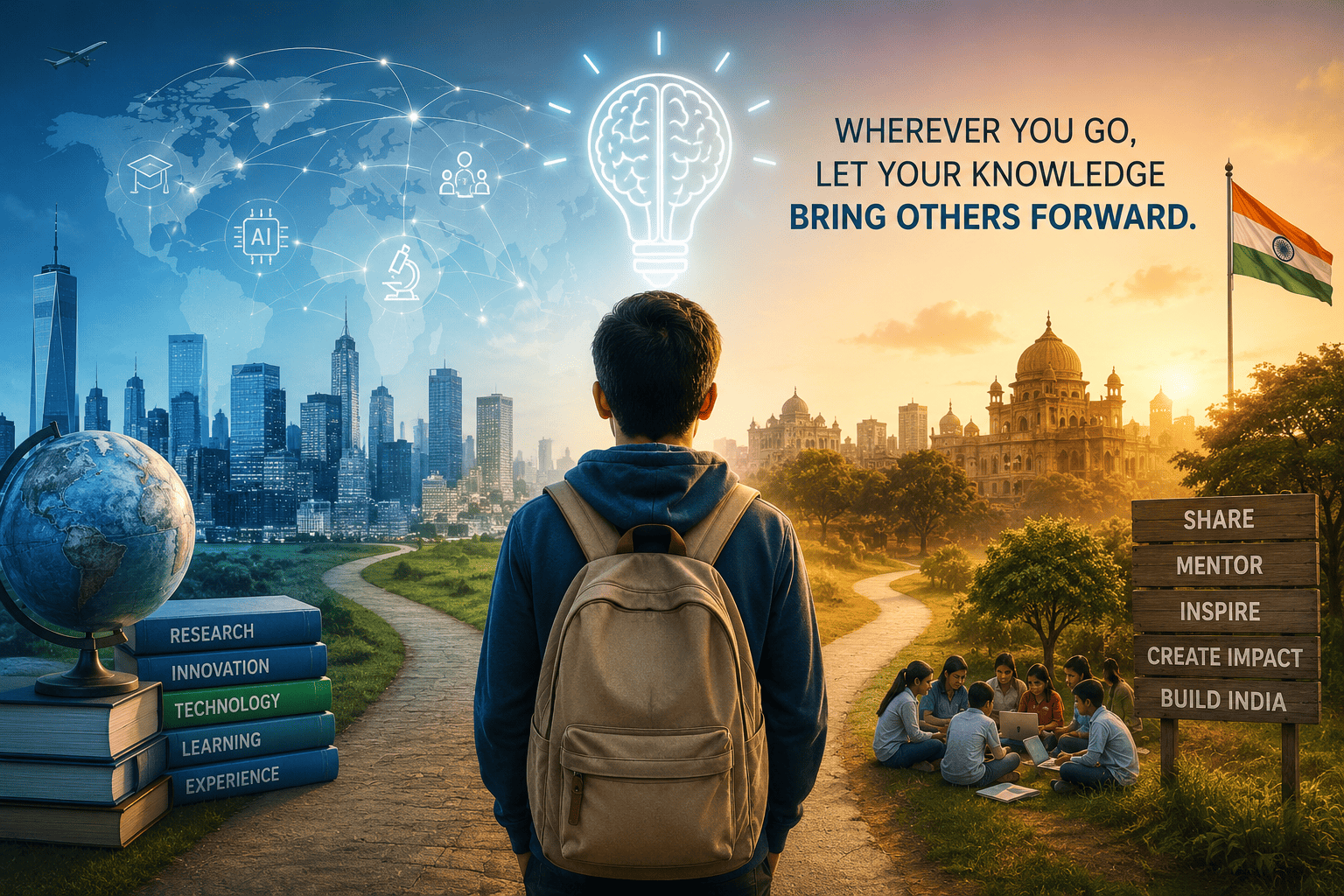
What happens to everything we learn after that? Because maybe brain gain is not about choosing between India and the world at all. Maybe it is about making sure that wherever we go, our knowledge does not stop with us. That changes the conversation completely.
Your brain can travel. Your impact can travel back.
Suppose you study artificial intelligence abroad. Brain gain does not necessarily mean returning home immediately and opening an AI company. It might mean mentoring two students here. Connecting an Indian start-up with a researcher you met there. Bringing a better way of doing something into your workplace when you return. Sharing what you learnt instead of keeping it locked inside your LinkedIn profile. Think of knowledge as Wi-Fi. Its value increases when more people can connect to it. That, to me, is the most exciting version of brain gain.
Also, can we stop waiting until 40 to “give back”?
This is something young people hear surprisingly often: First establish yourself.
Then help others.
Why?
If you learnt Canva this year, you can teach someone today. If you cracked an internship interview, tell your juniors what worked. If you discovered a useful scholarship, share the link instead of guarding it like classified information. If your school project actually solves a problem, don’t pack it away after the exhibition. Find someone who can help you make Version 2.You don’t need a designation to create opportunity for someone else. You just need to be one step ahead and willing to turn around.
And maybe we should start looking at ordinary problems differently
A traffic signal where everyone honks. A neighbourhood where water is wasted. A grandparent struggling with an app. A student unable to access a learning resource. Most of us look at these things and think, “Someone should do something.”
Innovation usually begins when somebody changes just one word: “Could I do something?”
That does not mean every teenager has to launch a start-up before finishing school. It means developing the habit of seeing problems as possibilities. Could there be a sensor? A better design? A simpler app? A campaign? A small business? A community project?
Sometimes brain gain is not a person returning from Silicon Valley.
Sometimes it is a 16-year-old deciding that a problem outside her school gate is worth solving.
And there is proof that knowledge brought back can multiply
India’s start-up ecosystem now includes more than 2.23 lakh DPIIT-recognised start-ups, which have created over 23 lakh direct jobs. But the more interesting part lies behind those numbers. Naveen Tewari studied and worked in the United States before returning and building InMobi. Mukesh Bansal spent years working in Silicon Valley before coming back and building Myntra, and later other ventures. Kunal Bahl returned from the United States and went on to co-found Snapdeal and support other entrepreneurs as an investor. What makes these stories worth noticing is not simply that these people came back. It is that what they brought back; experience, confidence, networks and ideas. That went on to create opportunities for many more people.
And that is the part we, as young people, can actually copy. Not necessarily the unicorn-building part. That may take a while. The multiplier effect part.
One more thing: collaboration beats being the smartest person in the room
We spend a surprising amount of our student lives competing. Marks. Ranks. Admissions. Internships. Placements.
Then the real world appears and says: “Great. Now work with people.”
Most meaningful ideas need more than one type of brain. The coder needs the designer. The scientist needs the communicator. The entrepreneur needs the engineer. The person with the problem needs the person who understands the technology. So perhaps one of the smartest things young people can build today is not another certificate collection. It is a network of people who know different things. Ask for help. Offer help. Collaborate. Introduce people. Because brain gain can be social too.
So, what does brain gain look like for us?
Probably nothing dramatic. It may look like sharing an opportunity instead of keeping it to yourself. Mentoring someone younger. Turning a class project into something real. Learning abroad and staying connected here. Coming back with skills. Creating jobs instead of only searching for one. Supporting a friend’s idea. Building something useful for your city. Choosing to solve one problem instead of complaining about ten. None of these requires us to decide today where we will live forever.
That is the beauty of it.
We can be global without becoming disconnected. We can chase individual success without making success individual. Perhaps that is the real upgrade from brain drain to brain gain.
The question is no longer: “Will India’s young people stay or leave?” The far better question is: “Wherever we go, how many people of India will move forward because of the skills we have learnt?” Now that is a brain worth gaining. That is brain gain.