
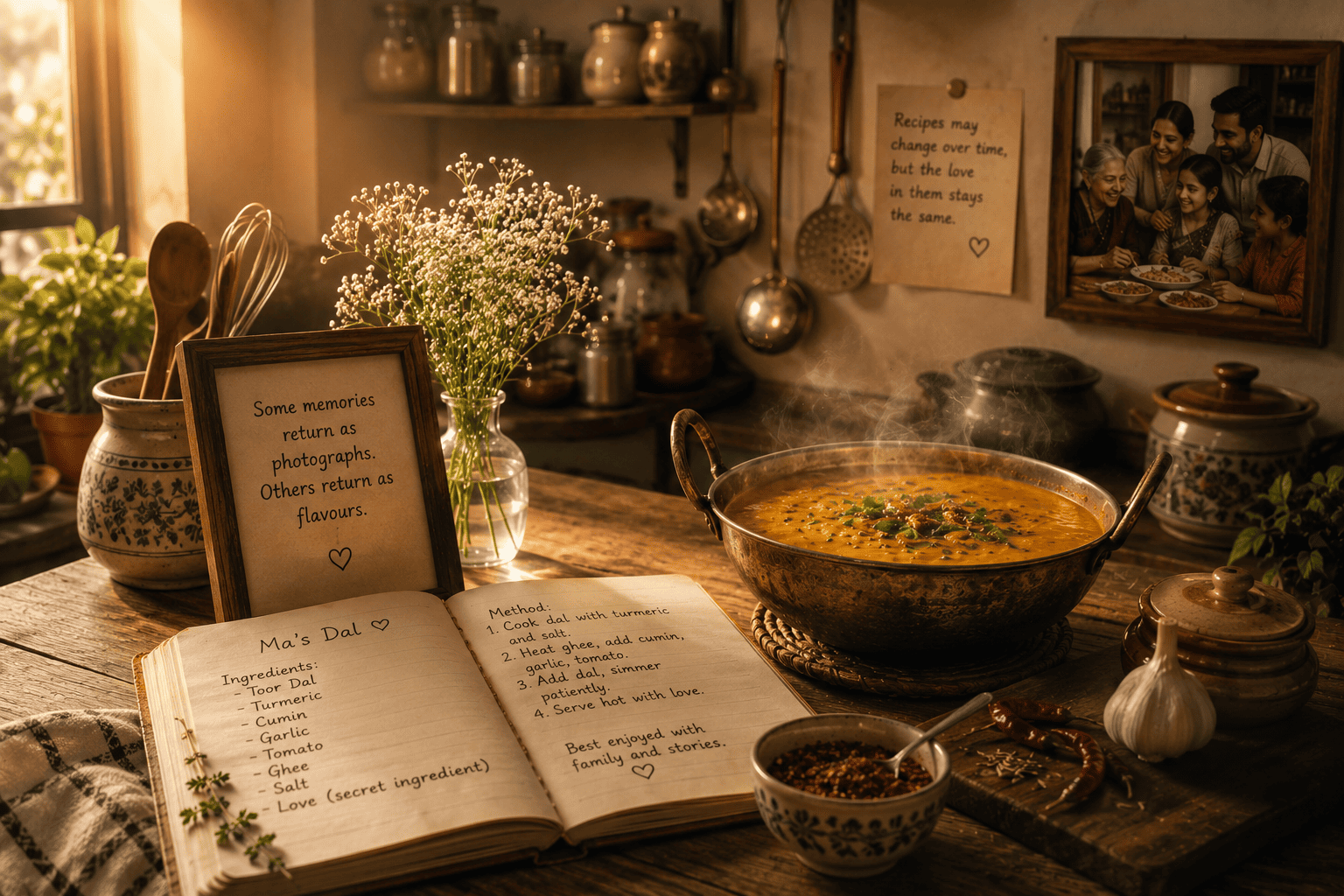
The Taste That Time Cannot Erase
Blog By - Bani Saluja (Grade - VIII)
Some memories return as photographs.
Others return as flavours.
You may forget what you wore to a family celebration ten years ago, who sat where, or what music was playing. Yet a single spoonful of a familiar dish can bring the entire day back with astonishing clarity.
The kitchen. The voices. The laughter. The person who served it.
Food possesses this extraordinary ability to endure long after the moment itself has passed.
And perhaps that is why food is never merely about hunger.
It is one of the ways we remember.
Sometimes, the recipe is really a person
Every family has at least one dish that seems to belong almost entirely to someone.
A grandmother’s pickle. A father’s Sunday breakfast. A mother’s festival sweet.
An uncle’s tea that somehow tastes different even though everyone uses exactly the same ingredients. Try recreating it and someone inevitably says, “It’s good, but it doesn’t taste like his.”That sentence reveals something important. The missing ingredient was probably never an ingredient at all.It was the person.
The way they cooked without measuring. The old vessel they always used. The extra pinch they never mentioned. The years of repetition that transformed instinct into technique.
Recipes quietly absorb the people who make them.
So, when those dishes are prepared again, we are not simply repeating instructions. In a small but profound way, we are continuing someone.
Moreover food also travels when people do
People move constantly now for education, careers, opportunities and entirely new lives. Homes change. Languages blend. Habits adapt. Food, however, is often far more reluctant to leave.
A student thousands of kilometres from home suddenly develops an intense affection for the ordinary dal they once complained about. Someone living abroad discovers that a packet of familiar spices can feel more precious than anything else packed in the suitcase. Families celebrate festivals in unfamiliar cities yet still insist that one particular dish must be prepared exactly the old way.
That is because food carries identity remarkably well. It does not need a passport. A recipe can cross borders, survive migration and adapt to ingredients available in an entirely different country while still quietly whispering, this is where you came from.
Over time, the recipe may change too. And that is not necessarily a loss of tradition. Sometimes, adaptation is precisely how tradition survives.
And then there is something else food does, something increasingly significant in a world of hurried conversations: it makes people sit down.
A family meal begins with food and somehow becomes an update on everyone’s lives. Friends meet for coffee and lose track of two hours. There is rarely an announcement saying, “We will now create an important memory.” It simply happens somewhere between asking for another roti and arguing over who gets the last piece.
We communicate constantly today, but communication is not always connection. A shared table slows us down just enough to listen. And perhaps that is why so many relationships are remembered through meals.
This is also why preserving the family recipes that created those memories becomes so important. And preservation can begin very simply.
Ask. Watch. Cook together.Write down the recipe, but also record the story behind it.
Who taught you this? Why is it prepared during this festival?
Because when we preserve a recipe, we preserve far more than a method of cooking. We preserve a fragment of somebody’s life.
Years from now, houses will change, technology will become obsolete and many things we consider important today will be forgotten. Then, one familiar aroma may rise from a kitchen, and suddenly, someone who has been gone for years will feel remarkably close again.
That is food’s extraordinary permanence. It does not merely survive in cookbooks. It survives in hands, habits, kitchens and memories.
We think we pass recipes from one generation to another. Perhaps what we are really passing on is home. And maybe that is why food outlives so much else. A photograph can preserve how a moment looked. A recipe can make us feel that moment again. Because some inheritances are not kept in lockers. They are served on plates.